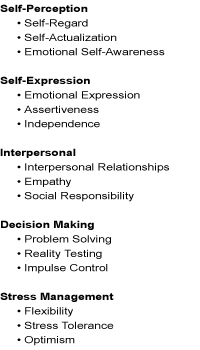
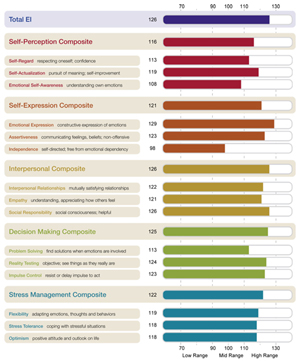
The HPS Emotional Intelligence Community is dedicated to the theoretical development, understanding, ethical use, resource development and global applications of the concept of Emotional Intelligence.
HPS’ Definition of Emotional Intelligence:
A person’s innate ability to perceive and manage his/her own emotions in a manner that results in successful interactions with the environment, and if others are present, to also perceive and manage their emotions in a manner that results in successful interpersonal interactions. ---Dr. Henry L. (Dick) Thompson, President & CEO, High Performing Systems, Inc.
Many believe that the concept of Emotional Intelligence (EI) began in 1995 with the publication of Emotional Intelligence: Why It Can Matter More Than IQ. To learn more about the actual origins of EI, however, click here or scroll down to Emotional Intelligence: Background.
Under the leadership of Henry L. (Dick) Thompson Ph.D., HPS has become a leading source of information, applications and research on Emotional Intelligence (EI) as well as its relation to leadership, stress and performance. Dr. Thompson also leads research on the relationship of EI measurement to other assessments such as the MBTI instrument, FIRO Element B and others.
Dr. Thompson’s experience and expertise in Emotional Intelligence have positioned HPS as a world leader in the Emotional Intelligence field. Some of his and HPS’ accomplishments are summarized below.
Dr. Thompson:
- Is a thought partner for the Human Capital Institute’s (HCI) Emotional Intelligence Community.
- Presents web casts for HCI on EI.
- Is a certifying instructor for the EQ-i, EQ-360 and the MSCEIT (Mayer-Salovey-Caruso Emotional Intelligence Test).
- Delivers training and coaching designed to improve EI competencies.
- Incorporated EI concepts into the Leadership Potential Equation™, an assessment that determines a leader’s potential to rise to various Levels in the organization. The LPE™ assessment evaluates leaders for promotion, job placement, succession planning and more.
- Has conducted seminal research on EI and stress.
A leader in the Emotional Intelligence field, High Performing Systems brings a multi-faceted approach to EI training, consulting and assessments. Our expertise is based on years of experience implementing customized EI concepts across industries.
- Leader Assessment (LPE, EQ-i, EQ-360, MSCEIT) and Development (HPL-I)
- Executive and Management Teambuilding
- Organizational Design
- Organizational Assessments
- Selecting Appropriate EI tools
- EQ-i and EQ-360 Certification
Call 706-769-5836 to get more information about specific needs or concerns from an HPS consultant.
Success Profiles
EI assessments have been shown to be very effective in creating Job Success Profiles. HPS uses EI tools and a scientific model to identify the specific, most critical-to-success EI characteristics for successful performance of jobs within an organization. Once the “success algorithm” has been developed, candidates for the job can be compared for “best fit.” Our clients have shown significant savings as well as increases in performance. The U.S. Air Force saves over $3 million a year using this type of process.
For decades, we have known that IQ can make a significant impact on job performance, and now research is showing that EI may be just as important, if not more so. For more information . . .
Competency Mapping
Competency mapping is similar to Success Profiles in that EI is “mapped” to organizational competencies (and in come cases, individual competencies). Our work and other researchers have shown that certain industries do well because they have a particular set of competencies and/or culture. Mapping EI to particular competencies (culture) enhances an organization’s probability of success. For more information . . .
Individual Feedback
The use of EI instruments for individual feedback is increasing rapidly in business, education, coaching and counseling. HPS feedback specialists are experts on the EQ-i and MSCEIT instruments and on providing individual feedback in a variety of formats. The EQ-i instrument provides a “reported” EI profile based on how an individual responded to the questions when completing the instrument. As with any psychological instrument, there is always some systemic measurement error. Additionally, a person’s mindset when completing an assessment may influence the accuracy of the report. Having a “bad hair” day could influence how someone responds. Thus, we strongly believe in one-on-one feedback to help a person “validate” their profile, ask questions and discuss next steps. Contact us to take an Emotional Intelligence Assessment and receive feedback. For more information . . .
Coaching
From individual contributors to CEO’s, HPS’ extensive experience with executive coaching is based on an integrated systems approach, the most effective means for accomplishing agreed upon objectives. In this type of approach, coaching and assessment go hand in hand. HPS uses a “multiple-lens” approach to more accurately determine an individual leader’s specific needs. The desired results of coaching can best be achieved by carefully selecting a pre-assessment process focused on the long-term needs of the leader and the organization. EI assessments provide foundational information for the coaching process. The EQ-360, which provides a multi-rater approach to assessing EI, is often used in the coaching process. For optimum results, an EI assessment is combined with our Leadership Potential Equation System of analysis to provide the most comprehensive leader assessment available. For more information . . .
Teambuilding
Emotional Intelligence has a significant impact on team member relationships and their effectiveness in reaching the team’s goals. Understanding our own EI strengths and weaknesses, as well as those of other team members, provides a means for improving the interpersonal dynamics of teamwork. The EQ-i Group Report can be used to enhance the understanding of the team/group’s EI. We often combine the EQ-i Group Report with HPS’ TeamWork Questionnaire (TWQ) to provide a more complete picture of the team.
Customized EI training can help team members learn how:
- individual EI “fits” with the EI of other team members, managers, clients etc.
- work assignments can be made and accomplished more effectively
- to improve communication
- to minimize the negative aspects of conflict
- to present information most effectively
- to design more effective problem solving groups
- to assist team members in maximizing their individual and collective strengths.
Understanding EI is one of the keys to improving team performance. Identifying EI and learning how to constructively use it helps team members maximize their task assignments and improve team performance. Special features of customized EI training include:
- Individual feedback
- Team/Work Group feedback
- Understanding Differences
- Working Together
- Building Trust
- TEAM Model™
Conflict
Emotional Intelligence significantly influences how we go about solving interpersonal problems. Thus, conflict in organizations often stems from EI differences. Understanding how to more effectively use our EI helps us solve interpersonal problems more effectively and efficiently, and increases the overall effectiveness of work teams. When people understand the basics of how they are different from each other and their strengths and weaknesses, they can take steps to reduce conflict and become more accepting. Customized EI training to manage conflict might include:
- Overcoming EI Differences
- Problemsolving Dynamics
- Emotional Dynamics
- Working Together
- Conflict Models
Although most people view emotional intelligence as being a relatively new field, fragments of the concept have been identified by cognitive intelligence researchers for over a century.
The first book on emotions was published in 1872—Charles Darwin’s The Expression of the Emotions in Man and Animals. This was the first comprehensive study and written account of the expression of emotions and is still valid today. Other researchers who discovered “something emotional about intelligence” include:
- 1920s – Edward Thorndike (social intelligence; emotional factors)
- 1940s – David Wechsler (“non-intellective aspects of general intelligence”)
- 1948 – R. W. Leeper (emotional thought)
- 1983 – Howard Gardner (multiple intelligences; interpersonal intelligence-people smart; intrapersonal intelligence-self-smart)
- 1980s – Reuven Bar-On (emotional quotient)
- 1990 – Peter Salovey & Jack Mayer (emotional intelligence)
Daniel Goleman’s 1995 book, Emotional Intelligence: Why It Can Matter More Than IQ, created an explosion of emotional intelligence research, books, instruments and training. In a sense, Goleman’s book created a cottage industry for emotional intelligence. It is doubtful that any other psychological construct has generated the volume of material in such a short period of time.
As with any emerging field of study, emotional intelligence is not without critics. In general, people tend to be divided into one of two camps. In one camp are the academics, whose approach is to research and examine thoroughly new fields of study prior to acceptance. This group tends to be critical of the concept of emotional intelligence as a unique and viable psychological construct. In general, Academics question:
- the validity of emotional intelligence, pointing out disagreement as to the definition.
- whether emotional intelligence is just repackaging of well established personality traits. They point to numerous studies that show what they classify as high correlations among the subscales of emotional intelligence instruments and those of other personality measures.
- the validity of emotional intelligence actually being an intelligence.
They tend to ask questions such as, “Where does emotional intelligence come from?” Is it innate, learned, or both?
Can EI be measured? What is the best measurement tool? Academics lean toward tests with right or wrong answers, not self-reports. It should be noted, however, that a trend is building toward acceptance of EI as something “real.”
The second camp includes those who believe that emotional intelligence is a viable construct. This group is largely made up of corporate trainers, researchers/practitioners who interpret the research data as supportive of a unique construct of EI. They point to numerous examples of the positive use of emotional intelligence in influencing individual and organizational performance.
This camp is divided, however, on disagreements over:
- The definition of EI
- How to measure EI
- Can EI be measured with a self-report instrument such as the BarOn EQ-i?
- Does it require an abilities-based model like the Mayer-Salovey-Caruso MSCEIT?
- Can EI be measured with a 360 instrument like the Goleman, Boyatzis ECI?
- Interpretation of the research data
- Which emotional intelligence model is the most accurate
Even with these internal disagreements, emotional intelligence has grown steadily in popularity as a viable psychological construct. This growth has been paralleled by efforts to use EI as a means for analyzing and improving individual and organizational performance. Business has deemed EI measurement as a tool worthy of being used alongside such longstanding assessments as the Myers-Briggs Type Indicator (MBTI), the California Psychological Inventory and FIRO Element B.
The controversy surrounding EI is sure to continue into the future. A mounting body of research says “there’s something there.”
Contact HPS for more information or to:
Take the EQ-i and receive feedback
Take the EQ-360 and receive feedback
Take the MSCEIT and receive feedback |